

Fraud Awareness Week 2026
Key Takeaways
-
The Association of Certified Fraud Examiners (ACFE) estimates organizations lose 5% of annual revenue to occupational fraud, highlighting the importance of fraud prevention.
-
Fraud schemes involving asset misappropriation, financial statement manipulation and executive misconduct expose gaps in internal controls and management oversight.
-
Fraud risk assessments, segregation of duties, internal audits and transaction monitoring help organizations detect fraud early and strengthen financial safeguards.
An investor statement that seems slightly off. Vendor expenses increasing steadily year over year. A trusted business partner assuring you that everything is going well and there is no cause for concern. The warning signs of fraud can be small, but ignoring them can lead to significant losses.
International Fraud Awareness Week, an annual global campaign organized by the Association of Certified Fraud Examiners (ACFE) gives organizations an opportunity to assess how they prevent, detect and respond to fraud.
Five investigations handled by our forensic accounting professionals illustrate how fraud can take shape across industries and reinforce findings from the ACFE’s Occupational Fraud 2026: A Report to the Nations (2026 RTN).
Based on over 2,400 cases across 143 countries, the report examines the costs, methods, victims and perpetrators of occupational fraud. Its findings suggest that the average organization loses an estimated 5% of their revenue to fraud each year! To repeat: that is FIVE PERCENT of top-line revenue!
Five Fraud Cases and Their Control Lessons
Financial Services
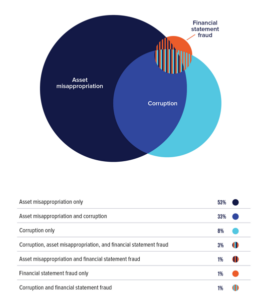
An institutional investor noted issues in the reporting of their investment in a private fund. After pursuing litigation to obtain the fund’s accounting records, the investor discovered that various schemes were being used to misappropriate assets, along with several instances of self-dealing and corruption. According to the 2026 RTN, financial statement fraud alone accounted for only 1% of cases. This investigation illustrates why evidence of financial statement fraud may warrant a broader review for asset misappropriation, corruption or other misconduct.
How Often Do Fraudsters Commit More Than One Type of Occupational Fraud?
Not-For-Profit
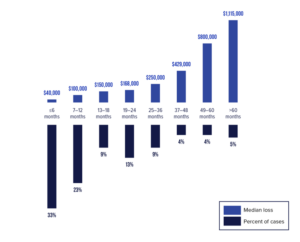
An employee at a charter school created a duplicate vendor and directed payments to go to their personal bank account. While individual payments to the vendor were not significant, the employee misappropriated a significant amount over several years. The 2026 RTN shows that longer-running fraud schemes tend to produce greater losses. Organizations should investigate small payment anomalies before repetition turns them into material losses.
How Does the Duration of a Fraud Relate to Median Loss?
Commercial
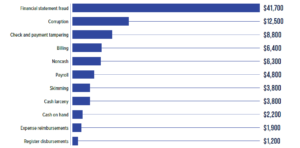
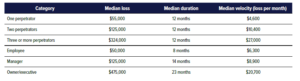
In the months leading up to the sale of a company, the existing owner manipulated the inventory system and generated customer invoices to bring additional cash onto the balance sheet before the sale closed with a new owner. Instead of reporting a corresponding liability, the owner manipulated the inventory system to show additional inventory on the company’s books. After the sale, the new owners were responsible for fulfilling prepaid customer orders for inventory that had never been produced. The size of this fraud could not have been perpetrated this quickly by a lower-level employee, as it involved gaining access to multiple systems and relied on existing customer relationships. The 2026 RTN reports that owner-related frauds have one of the highest losses per month, second only to schemes involving three or more perpetrators.
What Is the Typical Velocity (Median Loss Per Month) of Difference Occupational Fraud Schemes?
Fraud Loss Velocity by Number of Perpetrators and Organizational Position
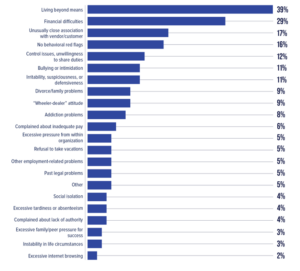
A second commercial case involved the CFO of a publicly traded company, who obtained reimbursements for unsupported expenses and paid himself both his board-approved salary and unapproved compensation as a contractor. A lack of segregation of duties and management oversight allowed the fraud to continue for over a year. The investigation also identified behavioral warning signs, including living beyond the individual’s means and financial difficulties. Organizations can use risk-based and legally compliant screening for executives and other positions of financial trust, together with appropriate oversight after hiring, to help uncover issues before they suffer damages.
How Often Did Perpetrators Exhibit Behavioral Red Flags?
Real Estate
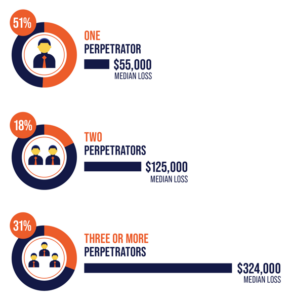
Two individuals responsible for the day-to-day operations of a hotel passed through their personal expenses and used their positions to obscure the transactions in the accounting records. When perpetrators collude with others, they can more easily bypass internal controls and negate established segregation of duties. Collusion is one of the most difficult aspects of a fraud scheme to defend against, but active detection methods, such as internal audits or account reconciliations, can help identify red flags.
How Does the Number of Perpetrators in a Scheme Relate to Occupational Fraud?
Internal controls should be living systems that evolve with your organization. International Fraud Awareness Week is an opportunity to revisit what has and hasn’t worked for your organization in the past. What part of your fraud prevention program can be strengthened, altered or needs an overhaul?
Takeaways and Actions
Organizations can use the lessons from these cases to strengthen fraud prevention and detection efforts, including:
- Review vendor setup, changes and payment activity for duplicate records, shared bank information and unusual trends.
- Confirm that no individual can initiate, approve and record the same transaction.
- Perform risk-based background checks for executives and employees in positions of financial trust.
- Use periodic account reconciliations, transaction testing and internal audits to identify warning signs early.
- Reassess fraud risks and internal controls after acquisitions, leadership changes, rapid growth or system implementations.
- Maintain confidential reporting and escalation procedures.
Detecting and Combating Fraud
Assess. Design. Forensic specialists have investigated and unraveled some of the most complex and notorious frauds of the last three decades. Are you confident in your organization’s current fraud controls? Are you unsure what controls you have in place or need? A fraud risk assessment ‒ including cybersecurity ‒ can help your organization identify control gaps, prioritize improvements and develop appropriate responses.
Test. An outsourced internal audit can provide periodic testing of transactions, controls and identified fraud risks. Internal audits were one of the most common methods by which fraud schemes were initially detected. Financial statement audits, while beneficial, are not designed to detect fraud. The 2026 RTN reports that, only 2% of frauds were initially detected by an external audit.
Investigate. If your organization identifies suspected or known fraud, qualified forensic accounting professionals can assist with a fraud investigation. Our professionals have investigated a wide range of schemes including global corruption and accounting malfeasance. We work with in-house and external counsel on urgent matters and can develop financial analyses and investigative findings to support counsel when an organization considers civil or criminal action.
Resolve. Remediate. After an investigation, we can work with a company’s board, management and counsel to address control failures and develop remediation measures responsive to the issues identified.
Contact Us
If you would like to discuss how we can advise you on forensic financial matters, contact a member of your client service team or:
Jon Klerowski, CPA, CFE, ABV
Partner
jklerowski@pkfod.com | 781.937.5729
Brian McDonough, CPA, CFE
Director
bmcdonough@pkfod.com | 781.937.5362
About the Association of Certified Fraud Examiners
Based in Austin, Texas, the ACFE is the world’s largest anti-fraud organization and premier provider of anti-fraud training and education. Together with more than 100,000 members, the ACFE is reducing business fraud worldwide and inspiring public confidence in the integrity and objectivity within the profession. For more information, visit ACFE.com
Source of all data and charts: Occupational Fraud 2026: A Report to the Nations. Copyright 2026 by the Association of Certified Fraud Examiners, Inc.