

When secondary-market transactions should and should not influence reported fair value
Key Takeaways
- Secondary-market transaction prices are not automatically fair value under Accounting Standards Codification (ASC) 820 and require analysis of timing, comparability and market conditions.
- Valuation committees should assess the unit of account and whether a secondary transaction was orderly before using its price as evidence supporting private-market fair value.
- Clear documentation of secondary transactions, market conditions and valuation judgments strengthens defensible net asset value (NAV) reporting and financial reporting compliance.
Fund managers, CFOs and valuation committees, investors and allocators and evergreen-fund sponsors are keeping an eye on secondary-market transaction activity as it continues to grow at a frenetic pace. GP-led transactions account for approximately half of the market. As a result, what those transactions signal for fair value is becoming an increasingly important question.
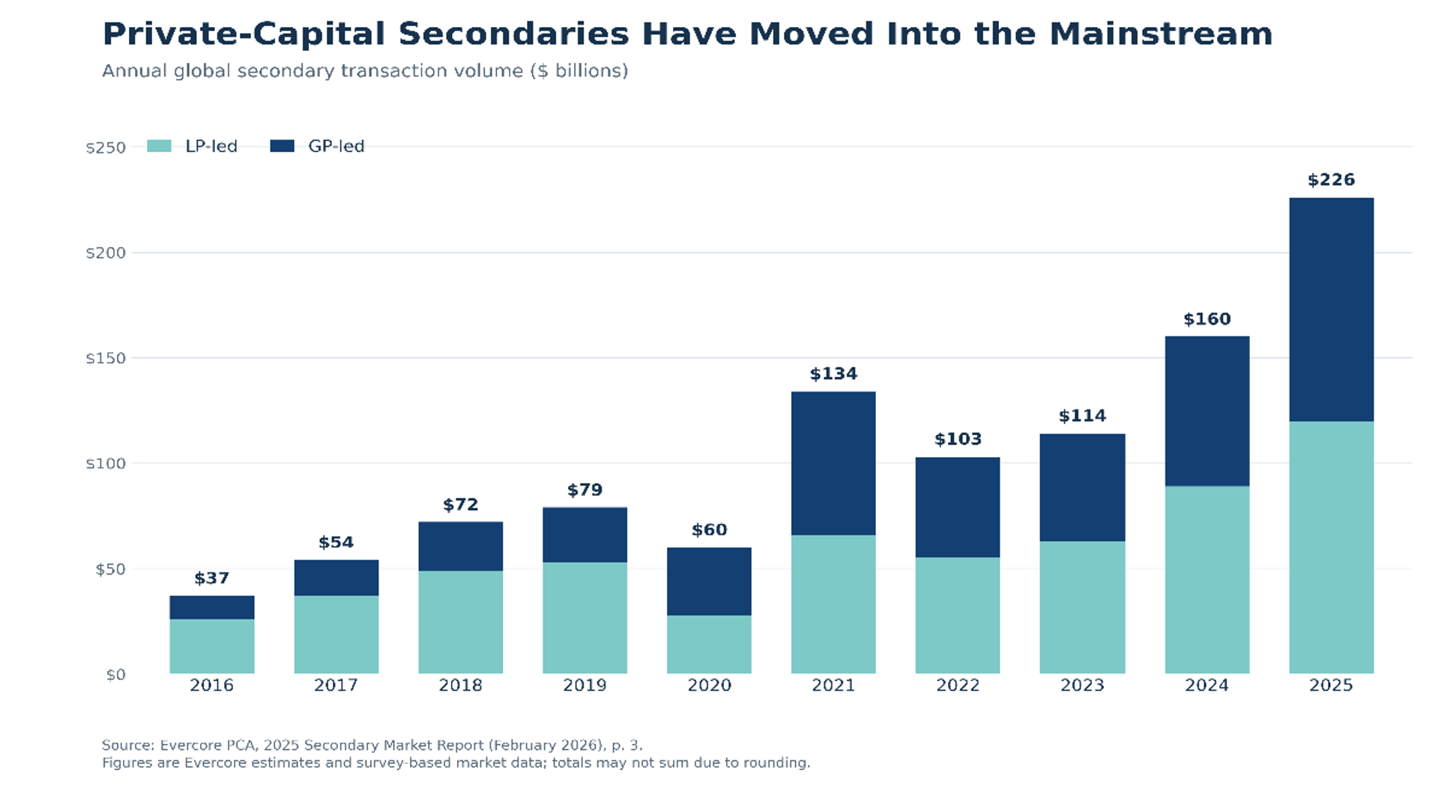
Recent transactions underline why this increase in private-capital secondary transactions matters. In August, BlackRock TCP Capital announced the transfer of a $523 million portfolio of private loans to a Pantheon-backed continuation vehicle, while retaining a minority interest in the new structure. Earlier this year, certain Blue Owl BDCs also agreed to sell $1.4 billion of direct-lending investments to institutional investors. These are not isolated transactions: well-known private-market managers are increasingly using secondary structures to create liquidity, manage portfolio risk and extend ownership of assets.
For valuation committees, however, a secondary-market price is not automatically a new fair value. It is a potentially important data point that must be assessed in the context of the interest sold, the transaction process, timing and conditions at the measurement date.
Accounting Standards Codification (ASC) 820 provides the framework for determining and reporting fair value in financial statements. For fund managers, valuation committees, investors and allocators, its relevance is practical: it governs how observable market activity should be evaluated when assessing whether reported net asset value (NAV) continues to reflect the price that would be received in an orderly transaction at the measurement date.
The valuation question comes into focus in two common situations:
Direct-company liquidity. A founder sells shares in a private company for $50 per share to obtain liquidity, while a private equity fund continues to carry the same investment at $70 per share under ASC 820.
GP-led continuation transactions and LP-interest secondaries. A GP arranges to sell one or more investments in its fund to new investors in a continuation vehicle at a discount to NAV.
ASC 820 defines fair value as an exit price. At first glance, each example appears to conflict with the fund’s reported fair value. Should the fund mark the shares down to reflect the founder’s transaction? Does a GP contradict its fair-value disclosures if it transacts at prices materially different from NAV?
These are precisely the scenarios that PKF O’Connor Davies guides clients through, particularly in an active secondary-market environment. We work with fund managers and valuation committees to assess the relevance and potential impact of secondary-market activity on reported fair value, including whether a transaction was orderly, comparable and reflective of conditions at the measurement date.
For evergreen structures, we help clients establish valuation and governance processes that support consistent NAV determination and equitable treatment of subscribing, redeeming and continuing investors.
A Practical Valuation Framework
The appropriate response depends on the facts and circumstances of the transaction. We recognize three important considerations:
1. Timing and conditions at the measurement date
There is usually a gap between a secondary transaction and the fund’s last reported NAV. During that period, market multiples may have expanded or contracted, credit spreads may have widened or tightened, and other relevant capital-market events may have occurred. Portfolio companies may also have achieved significant milestones that influence fair value but are not reflected in the latest NAV.
The longer the period between the last valuation and the secondary transaction, the more likely the transaction contains information that was unavailable at the previous measurement date. Valuation committees should, therefore, determine whether the transaction reflects conditions that existed at the prior measurement date or incorporates information that arose afterward. To address this challenge, many funds, particularly evergreen and other funds experiencing frequent redemptions, are moving toward more frequent NAV reporting.
2. The unit of account
Whether a secondary transaction provides persuasive valuation evidence depends on the interest being sold. A transaction in a direct interest in a portfolio investment may provide evidence relevant to that investment’s fair value. By contrast, a transaction in an LP interest is a transaction in the fund as a whole. Its price may reflect fund-level attributes, including portfolio mix, fees and expenses and liquidity, rather than the fair value of any one underlying investment.
Documentation is more robust when it considers all observable transactions in the fund or its assets as part of the valuation process, even where transactions are not comparable and are ultimately assigned little weight in the analysis.
3. Whether the transaction was orderly
ASC 820 assumes orderly transactions, whereas not every secondary transaction represents one. Consider an overleveraged fund that must sell illiquid investments at a discount to service debt or other financial obligations. In assessing whether a transaction is orderly, valuation committees should consider the fund’s liquidity runway, debt maturities, covenant headroom and whether the seller had adequate time to market the interest to multiple potential buyers.
Financial stress alone does not make a transaction non-orderly. However, a sale made under a near-term need for cash may be less persuasive evidence of fair value.
Applying the Framework
When reconciling a secondary-market transaction with financial-reporting estimates, valuation committees should consider the following questions.
Is the transaction orderly?
- Market process: Did the transaction involve participation from multiple bidders?
- Parties to the transaction: Are the buyer and seller knowledgeable investors and able to transact?
Is it comparable to the interest being valued?
- Scope: Does the transaction involve one investment, some investments or the entire portfolio?
- Market context: Does the observed discount align with similar funds or asset classes?
- Control: Does the transaction involve a different level of control from the fund’s ownership percentage?
Does it reflect conditions at the measurement date?
- Timing: How much time has elapsed since the last disclosed fair-value estimate?
- Subsequent events: Did any underlying investment achieve milestones since the last reported NAV?
Reaching a Defensible Conclusion
There is no prescribed formula for determining how much weight to assign to a secondary transaction. However, valuation committees can improve the defensibility of their conclusions by clearly documenting the transaction’s relevance, comparability and limitations. As the quality of transaction evidence and its comparability to the interest being valued, increases and greater weight may reasonably be assigned to the observed price.
The objective is not to quantify weighting with artificial precision, but to demonstrate that all relevant facts and circumstances were considered in reaching the fair-value conclusion.
How PKF O’Connor Davies Can Help
Secondary transactions involve both scrutiny and judgment. PKF O’Connor Davies partners with fund managers, valuation committees and investors to assess secondary-market evidence, document clear and defensible fair-value conclusions, and strengthen valuation processes supporting financial reporting and investor decision-making. Our valuation professionals provide recurring portfolio valuation, fair-value and financial-reporting support, as well as scenario-based analysis for complex transactions.
Contact Us
If you would like to discuss how we can help, please contact your PKF O’Connor Davies client service team or a member of our Valuation team below:
Noam Hirschberger, CFA, CVA
Partner
nhirschberger@pkfod.com | 212.286.2600
Shalini Chandran, FRM
Managing Director
schandran@pkfod.com | 908.272.6200
Helen Rexwinkel
Partner
hrexwinkel@pkfod.com | 203.323.2400