

Key Takeaways
- Chief accounting officer (CAO) infrastructure strengthens audit readiness through accounting memos, policies and controls that support consistent financial reporting and defensible accounting judgments.
- Financial Accounting Standards Board (FASB) Accounting Standards Codification (ASC) research and documented analysis support revenue recognition and new accounting standard adoption.
- Outsourced CAO support embeds accounting conclusions into policies and internal controls, improving compliance, audit readiness and transaction preparedness across the enterprise.
In the first article of this series, Accounting Judgments: A Critical Business Capability, we described the chief accounting officer (CAO) role and the gap it fills. In this article, we turn to the work itself: the accounting memos, policies and controls that form the accounting infrastructure. A strong infrastructure makes financial information reliable, audit-ready and usable by lenders, investors, boards and acquirers.
For many organizations, the absence of this infrastructure is invisible until it is tested: the audit request list expands, a lender asks for support, a buyer challenges an accounting position or a board asks why a policy was applied inconsistently across business units.
Below, we share four accounting infrastructure examples, review the CAO role in each scenario and highlight the benefits an outsourced CAO team can provide.
1. Technical Accounting Memoranda
An accounting memorandum is the written record of an accounting judgment; it articulates the facts and rationale behind why you handled an accounting transaction a certain way. When a customer agreement raises a question about how revenue should be recognized, a compensation arrangement includes complex features or a new accounting standard must be adopted, someone must research the applicable guidance, apply it to the specific facts and document the conclusion. That document is the accounting memo or position paper.
The process to produce an accounting memo should follow a consistent sequence, as below:

The resulting memo should give stakeholders (management, auditors, future staff) a defensible record of your entity’s accounting judgment or position. For example:
- Document: An entity signs a customer contract that includes several items purchased by the customer. Each item may represent a distinct “performance obligation” under the accounting literature. All should be documented in the memo.
- Isolate: Those performance obligations may raise accounting questions, such as whether revenue should be recognized ratably over time or at a specific point in time. The memo helps isolate each question that must be researched and answered.
- Research: Addressing those questions would require researching and referencing the Financial Accounting Standards Board’s (FASB) Accounting Standards Codification (ASC) and potentially other guidance. For example, FASB ASC paragraphs 606-10-25-23 through 25-30 would be studied to determine whether a performance obligation is satisfied over time or at a point in time.
- Analyze, Conclude and Illustrate: With the research completed and analyzed, the memo may conclude that there are three distinct performance obligations, with three separate recognition patterns, and list sample journal entries for each as illustration.
2. New Accounting Standards
A new accounting standard creates the same need for judgment as a complex contract, but the work is broader. Management must determine whether the standard applies, identify which transactions, accounts and business processes are affected, evaluate policy elections and transition methods and document the conclusion before the close process is under pressure. The question is not only what the standard says, but how your organization will apply it consistently. The process for documenting and implementing new accounting standards should also follow a practical sequence:
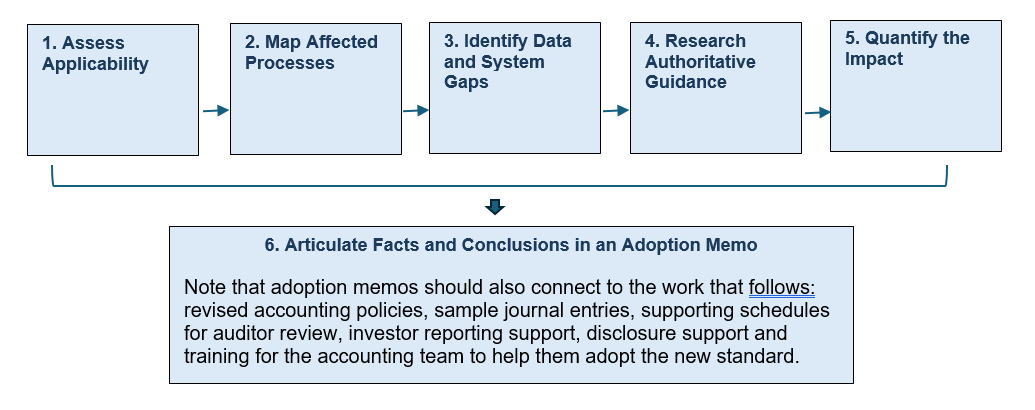
A CAO and dedicated technical accounting function would drive and bring structure to this end-to-end scope of work.
3. From Accounting Memos to Policies
Accounting memoranda guide how an entity accounts for routine transactions and events. Accounting policies help enforce compliance and consistency. Accounting policy development is not about writing a manual. It is a risk-and-controls exercise that begins with a question: Where is your organization exposed to misstatement?
The assessment identifies gaps between current practices and applicable standards, controls that are absent or inconsistent across business units and areas where your organization’s growth has outpaced its accounting infrastructure. The resulting policies should be embedded into your organization’s internal control framework.
When policy and a prior memo diverge, whether due to updated standards or evolving organizational operations, the relationship should be resolved explicitly. The accounting policy manual should reference the memos as supporting documentation and the memo archive should clearly indicate any positions that have been superseded by subsequent policy decisions.
A scalable approach to accounting memo and policy development may be considered through the lens of your entity’s key business processes, such as those involving your customers, suppliers and workforce. The chart below shows critical process areas, along with CAO memo and policy needs.
Process | Typical Transactions | CAO Memo and Policy Need Examples |
Order-to-Cash | Customer contracts; variable consideration; returns; warranties | Revenue recognition memos; ASC 606 five-step policy; ASC 326 and credit loss reserves |
Procure-to-Pay | Supplier agreements; service contracts; embedded leases; prepaid arrangements | Expense recognition memos; ASC 842 lease classification policy |
Hire-to-Retire | Equity-based and deferred compensation; benefit obligations; severance | Compensation memos; ASC 718, ASC 712, ASC 715 policies |
Record-to-Report | Close; consolidation; intercompany; tax provision; impairment; lease modifications | Consolidation memos; impairment policy; tax accounting support; intercompany procedures |
Treasury | Debt instruments; derivatives; foreign currency; investment classification | Debt and investment memos; ASC 470, ASC 815, ASC 320 and ASC 321 policies |
Corporate Development | Acquisitions; divestitures; joint ventures; mergers; restructurings | Transaction-specific memos and purchase accounting (see Article 3) |
Each of these process areas generates transactions that require documentation, policies and controls. Viewed commercially, Figure 2 can function as a CAO readiness map. It connects operational activity to the memos, policies and controls that help make accounting judgments defensible across the enterprise.
4. The Control Environment
As mentioned, your organization’s accounting policies should be embedded into your internal control framework. Even for organizations that are not required to maintain formal internal controls over financial reporting, a well-designed control environment provides structure for reliable reporting and accountability that lenders, investors, tax stakeholders, donors and board members may expect. It should include preventive and detective controls, segregation of duties. and system-enforced workflows.
In our experience, organizations that build this voluntarily are better positioned when a funder, regulator or acquirer asks for it. A dedicated CAO function would drive and structure this work.
CAO Support to Advance Your Accounting Infrastructure
If your organization lacks a dedicated technical accounting function, outsourced CAO support can bring structure to this work. The outsourcing team will work alongside management to draft technical or adoption memos, build implementation plans and help translate accounting conclusions into recurring activities. Management retains ownership of the accounting judgment. The outsourced CAO team would help make the judgment clear, documented, operational and ready for auditor review. A dedicated CAO team is also equipped to take the required next steps to embed conclusions into policies and controls.
Audit readiness would follow a similar discipline: the controller may own the schedules, but outsourced CAO support will help make the underlying judgments, policies and support ready before fieldwork begins, when there is still time to resolve issues without disrupting the close.
A dedicated CAO team will help ensure that your accounting infrastructure keeps pace with operational growth. That infrastructure is precisely what your organization will rely on when a strategic transaction arrives, the subject of the final article in this series: Sixty Days to Close: Uniting Strategy and Accounting.
Contact Us
If you have any questions or would like to explore our outsourced CAO capabilities, please contact your PKF O’Connor Davies client service team or the article authors:
Roman Z. Matatov, CPA, MBA, FPAC, FMVA, CGMA, CITP, CVA, CFE, CFF
Partner
rmatatov@pkfod.com
Mark Bednarz, CPA, CISA, CFE
Partner
mbednarz@pkfod.com
Patrick R. O’Beirne, CPA
Partner
pobeirne@pkfod.com
Michael D. Mekler, CPA
Director
mmekler@pkfod.com
Kapil Rajgor, CPA
Director
kraigor@pkfod.com
Anthony Capobianco, CPA
Director
acapobianco@pkfod.com
Next in this series: Sixty Days to Close: Uniting Strategy and Accounting. The article reviews accounting for strategic transactions, including day-one advisory, purchase price allocation, the twelve-month review, integration and value protection.