
Key Takeaways
- Accounting judgments require Chief Accounting Officer (CAO) expertise to support Generally Accepted Accounting Principles (GAAP) compliance, technical accounting, internal controls and defensible financial reporting.
- Business growth, acquisitions and complex transactions expose accounting gaps that can lead to audit findings, reporting delays and regulatory compliance risks without documented policies and accounting memos.
- Outsourced CAO services provide scalable technical accounting, transaction accounting and policy governance, helping strengthen reporting infrastructure and protect enterprise value before a full-time CAO is needed.
There are certain functions of accounting where the performing role is clear: controllers balance the books; chief financial officers (CFOs) determine the soundness of a financial strategy. But when a complex transaction arises, a new standard or tax rule takes effect, an agreement contains ambiguous conditions or an acquisition is on the table, who assesses the accounting treatment, documents the basis for that conclusion and helps it withstand further analysis? A question we hear regularly from business owners and leaders is: “Who is making sure our accounting judgments are reliable and defensible?”
That expertise describes the domain of the chief accounting officer (CAO). Not every organization has that title. Some call it the principal accounting officer, VP of technical accounting or the director of financial reporting. But the role is distinct regardless of the label: the CAO is responsible for the integrity of the accounting itself.
While that may sound straightforward, the function is incredibly complex because of the scope of knowledge, experience and strategic insight required to perform it. Ensuring accounting integrity encompasses:
- Technical accounting judgments
- Income tax accounting and tax-related financial reporting considerations
- Investor-reporting inputs
- Accounting policies
- Internal controls over financial reporting
- Regulatory compliance that governs how the organization records its economic activity.
It’s rare to find this diversity of expertise in one person, which is why in many mid-market businesses, the CAO capability does not exist as a dedicated role, causing a critical gap.
The Gap Most Organizations Don’t See (Until Complexity Arises)
We often see that the CAO capability is distributed across a controller and others already managing the close, the general ledger or daily accounting operations. This gap often isn’t exposed until a business inflection point: a first audit, a lender request, a customized revenue contract, an equity award plan, a board reporting package or a potential sale or acquisition.
When such complex accounting questions arise, the existing accounting team may have to make a judgment with limited time and resources. The issue is rarely whether the accounting team is working hard enough. It is whether the organization has the technical accounting capacity to make judgments before those judgments become audit findings, diligence issues, delayed reporting or value leakage.
In many instances, businesses turn to their external auditor, who can be an important sounding board but is not a substitute for management’s own accounting function. The auditor’s role is to evaluate the financial statements for material misstatements, not build an organization’s accounting capabilities.
The absence of a dedicated CAO capability can have profound negative implications for your company:
- Accounting positions can go undocumented and challenged later during an audit, financing process or diligence review.
- Accounting policies can drift from current standards or actual operations until a lender, auditor, board member or acquirer asks for support.
- Transaction-related errors can produce misstated financials, delayed reporting, purchase price disputes or avoidable management distraction.
What the CAO Actually Does
The CAO’s role includes designing and overseeing outputs of the accounting department regarding:
- How a complex arrangement should be recorded
- Which policies should govern day-to-day transactions
- Which controls should be in place to foster consistency and mitigate risk
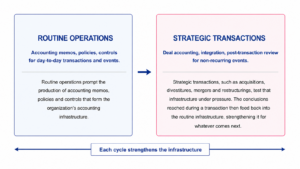
These determinations span two broad categories: routine operations and strategic transactions.
How Demands Shift as Organizations Mature
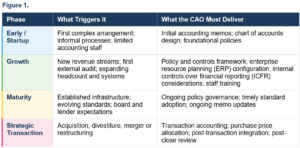
The intensity and nature of this work change as an organization grows. What triggers change is not the passage of time but the arrival of complexity, such as a new revenue stream, a first audit or an acquisition. Figure 1 below summarizes the demands on a CAO throughout typical organizational phases.
Signals You May Need CAO Services
Most business leaders usually do not describe the problem as a need for CAO services. They instead describe the symptoms:
- The external auditor is asking for accounting memos the company does not have.
- Revenue arrangements, leases, equity awards or debt agreements have become too complex for informal treatment.
- Lenders, investors, donors or board members are asking for more reliable GAAP reporting support.
- Management is preparing for a first acquisition, sale process, financing or audit.
- The controller is expected to close the books and resolve technical accounting questions at the same time.
While these symptoms can’t be ignored, divvying up the role across staff is rarely the right fix. Instead, these moments highlight when a flexible CAO model can protect management time, reporting credibility and enterprise value.
Building CAO Capability Through Outsourcing
Many mid-market businesses do not need a full-time CAO or cannot justify the cost. But they still face the accounting complexity the CAO role is designed to address, such as new revenue arrangements that require analysis, lease portfolios that demand judgment, equity-based compensation and acquisitions that trigger purchase accounting for the first time. This type of work exists whether or not your organization has a CAO.
An outsourced accounting team can help fill your missing CAO gap by delivering CAO-level capability on a flexible, scalable basis. An experienced team brings technical depth, from accounting research and memo drafting, to accounting policy architecture and transaction accounting without requiring a permanent addition to your organizational chart.
A CAO Team at Your Service: How it Works
The outsourced CAO team will work alongside your controller and CFO, not above them. Your management will retain ownership of every accounting judgment, while the advisory team drafts the analysis, presents defensible options and documents the conclusion management selects.
In our experience, this model works best when the relationship between the business and the outsourced accounting team is continuous rather than episodic. A team that understands your organization’s chart of accounts, industry, auditor expectations and historical accounting positions can respond faster, build on prior work and identify emerging issues before they become problems. The result is not dependency on an outside service provider, but durable CAO-level infrastructure and institutional knowledge that your business controls and management can sustain over time.
Stated differently, the value proposition is not simply outsourced accounting. It is value protection and decision support in the form of defensible judgments, consistent policies, audit-ready support and transaction-ready accounting infrastructure delivered before the business can justify a permanent CAO.
Contact Us
If you have any questions or would like to explore outsourced CAO capabilities, please contact your PKF O’Connor Davies client service team or the article authors:
Roman Z. Matatov
Partner
rmatatov@pkfod.com
Michael D. Mekler
Director
mmekler@pkfod.com
Kapil Rajgor
Director
kraigor@pkfod.com
Anthony Capobianco
Director
acapobianco@pkfod.com
Next in this series: “Accounting Infrastructure for Reliable Financial Information,” technical accounting memoranda, policy and controls implementation, audit readiness and the business processes that depend on them.