
Key Takeaways
- A strong alliance between the chief financial officer (CFO) and chief human resources officer (CHRO) aligns workforce planning, talent strategy and financial discipline with business goals.
- During rapid growth, mergers and acquisitions or cash-flow disruptions, CFO-CHRO collaboration supports workforce flexibility, cost management and business continuity.
- Strategic workforce redesign combines permanent, temporary and outsourced talent with ongoing workforce assessments to strengthen organizational resilience and talent retention.
When the realization hits that your existing teams no longer fit the business, it’s time for a workforce redesign. These insights often arrive at an inflection point: a rapid growth phase, corporate transaction or cash-flow squeeze. In each of these scenarios, two leaders are under particular pressure: the chief financial officer (CFO) and the chief human resources officer (CHRO).
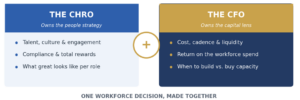
The CFO owns the financial mandate as it relates to human resources, including the cost, timing, liquidity and investment returns. The CFO also plays a key role in evaluating when to invest in additional talent and capabilities. The CHRO owns the talent strategy and oversees the HR function that encompasses workforce planning, talent management, employee relations, company culture and compliance.
Why Build a CFO-CHRO Alliance?
When these inflection points arise, critical decisions involve capital and talent at the same time. The CFO and the CHRO will achieve better results if they work together to realign the workforce to what the business needs. A talent strategy without financial discipline overspends. Financial discipline without a talent strategy undercuts the business. The CFO and CHRO who commit to working together will design a workforce with strategic intention and enable the business to emerge on more solid footing.
Three Transitions That Test the CFO-CHRO Alliance
Three scenarios demonstrate where a strong alliance can help leaders succeed in navigating change. An experienced external partner can help them agree on a path forward and then execute the plan.
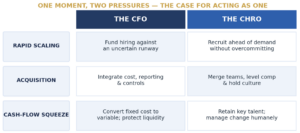
1. Opportunity for Rapid Scaling
When demand grows faster than the capacity of teams to deliver, the CHRO must expand capacity while preserving the culture. The CFO looks at the bigger picture of talent investment against an uncertain outlook. If they don’t hire quickly enough, growth stalls. If they hire too quickly, costs can outrun revenue. The right approach is usually a blended talent mix. Core roles remain permanent, with specialized capacity brought in on a temporary basis. Outsourcing gives the business flexibility, so leadership can capitalize on opportunity while keeping risk under control.
2. Corporate Transaction
In an acquisition or merger, workforce issues are at the top of the agenda. On the financial side, the CFO must integrate cost structures, financial reporting and internal controls. The CHRO needs to optimize teams throughout the business, adapt compensation and retain key talent. It’s no small task to also bring two cultures together to make one that will continue to drive business success. These leaders must make change happen while still running day-to-day operations. Outsourcing is a common solution to the demands of this transition period. Specialized support across finance and HR on a temporary basis can help leaders to drive more strategic, less reactive, integration and ultimately strengthen the business.
3. Cash-Flow Disruption
In situations where future cash flow is uncertain, the CFO has to protect liquidity and shift the balance of cost from fixed to variable where possible. The CHRO needs to manage change on the talent front, retaining key people while keeping employees engaged. At the same time, both leaders need to take action in ways that won’t drain the business’ capacity to recover. In this case, outsourcing becomes a deliberate strategic lever. Working with an external partner can open up a range of options that can get the business through to a clearer path. In this scenario, even core functions can become temporarily variable, providing the ability to flex capacity quickly when conditions change.
After the Inflection Point: An Opportunity to Reset
When businesses have completed a transition, leaders have an opportunity to take a step back and reassess the workforce strategically. From our experience, the strongest CHRO-CFO partnerships approach this as a repeatable loop, undertaken after each transition, in which they assess current state and evaluate what the business needs. They may gather input from others, but the view they come to is their own.
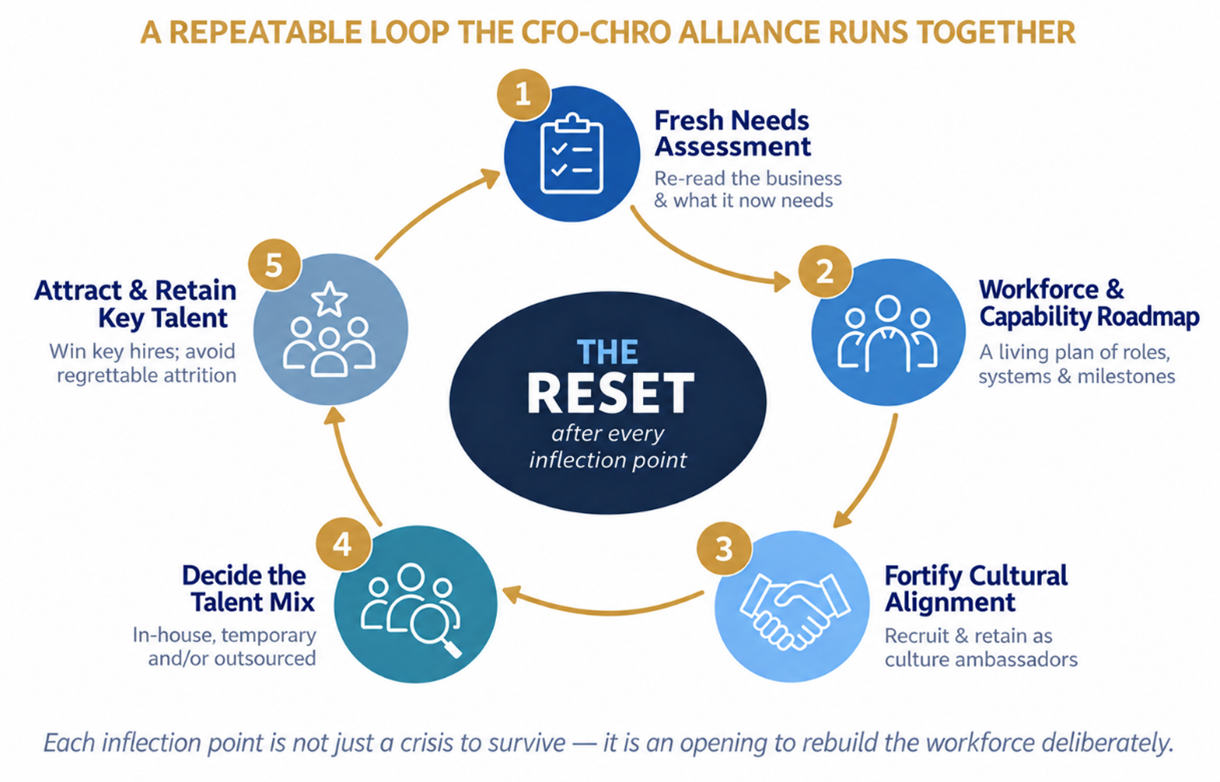
With this analysis, leaders can build a living roadmap that outlines the workforce and capabilities needed to move forward. It includes talent, technical expertise and infrastructure. Milestones will evolve as the plan is executed. When shared with internal teams, this roadmap provides strategic vision, tactical direction and a sense of how teams contribute to the plan.
Strengthening cultural alignment is the next step in the process. As the workforce evolves, each leader serves as a culture ambassador. They are clear on foundational principles: the talent mix, team structures and roles, approaches to talent development and internal values.
The CHRO and CFO must decide on the talent mix. Together, they identify which roles should be permanent, temporary or delivered through outsourced or co-sourced teams.
With that groundwork laid, focus shifts to attracting key talent and avoiding attrition that would impact the business. The CHRO matches talent to core responsibilities, proactively building trust along the way. Trust is what keeps the talent that would be most costly to lose.
Run once, these steps provide stability. Run as a loop that is revisited after each transition, they enable a workforce that evolves with growing competence, better alignment and higher resilience.
How We Support the Alliance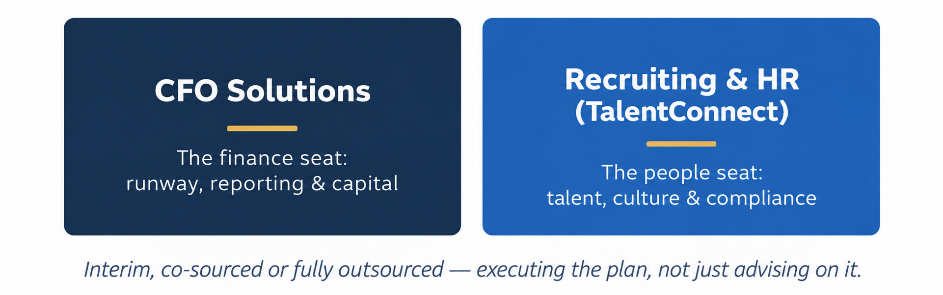
PKF O’Connor Davies CFO Solutions support the finance seat through critical decisions: cash flow and liquidity, reporting, controls and capital. TalentConnect, our Recruiting and HR practice, provides the CHRO with both strategy and talent across the full talent lifecycle, including full-time, seasonal or temporary roles. Whether interim, co-sourced or fully outsourced, these solutions enable leaders to implement the workforce they design according to the timeline needed.
The CFOs and CHROs who emerge from these situations in the strongest position are the ones who face challenges together. This is where PKF O’Connor Davies Outsourced Services practice earns its place as a trusted execution partner to both leaders.
Contact Us
If you have any questions or would like to explore outsourced CFO and/or CHRO capabilities, please contact your PKF O’Connor Davies client service team or the article authors:
Roman Z. Matatov, CPA, MBA, FPAC, FMVA, CGMA, CITP, CVA, CFE, CFF
Partner
PKF O’Connor Davies
rmatatov@pkfod.com | 240.534.2797
Steve Frey
Recruiting Services Director
PKF O’Connor Davies TalentConnect
sfrey@pkfod.com | 914.341.7616
Next in this series: “When HR Outgrows the Operating Model.” Once the CFO and CHRO have gone through a business transition, the next question is infrastructure. Can HR’s operating model support the new evolving workforce?